
Two days of insights, case studies, and strategies for building AI-ready, data-centric enterprises
The Enterprise Data Transformation Symposium (EDTS) will convene data leaders, executives, and innovators to explore modern approaches to managing and leveraging organizational data. The event will focus on building momentum and alignment for data initiatives while avoiding common pitfalls that hinder transformation. Our symposium also highlights the use of open-source, standards-based tools to reduce vendor lock-in and promote sustainable data ecosystems. Attendees will learn how data-centric thinking can support ethical, effective generative AI and drive the future of enterprise intelligence.
All times are in Mountain Time.
Day 1 – 2/9
| 8:00-8:30 | Introduction |
| 8:30-9:30 | Ora Lassila, Amazon |
| 9:30-10:30 | Katariina Kari, ExClam! Digital |
| 10:30-11:00 | Break |
| 11:00-12:00 | Mike Pool, Bloomberg |
| 12:00-1:00 | Bilal Mahria, TeamEx |
| 1:00-1:30 | Break |
| 1:30-2:30 | Alexandre Bertails, Netflix |
| 2:30-3:30 | Ashleigh Faith, IsA DataThing |
| 3:30-4:30 | Open Networking |
Day 2 – 2/10
| 8:00-8:30 | Introduction |
| 8:30-9:30 | Martin Romacker, Roche |
| 9:30-10:30 | Ben Gardner, AstraZeneca |
| 10:30-11:00 | Break |
| 11:00-12:00 | Nick Lynch, Curlew Research |
| 12:00-1:00 | Ryan Chandler, Abbvie |
| 1:00-1:30 | Break |
| 1:30-2:30 | Dougal Watt, Graph Research Labs |
| 2:30-3:30 | TBD |
| 3:30-4:30 | Closing Remarks |
Featured Sessions & Speakers
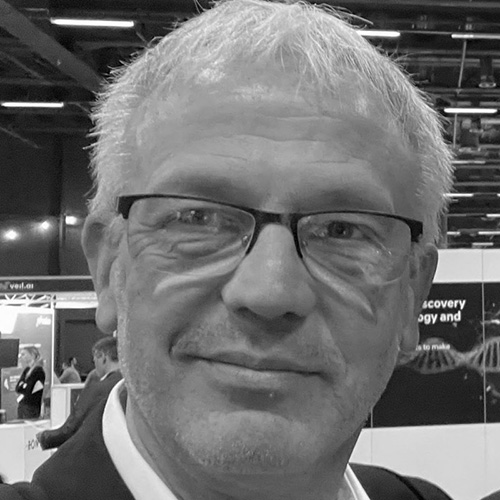
Martin Romacker (Roche)
Product Manager – Roche Data MarketplaceModel-driven Application Design based on a FAIR Semantic Metadata Registry
As enterprises race to scale AI, the governance of high-quality metadata has become the critical bottleneck. To build a truly solid foundation, organizations must move beyond disparate digital repositories toward a unified semantic layer. This presentation explores how implementing a semantic metadata registry establishes business-layer connectivity by applying FAIR (Findable, Accessible, Interoperable, Reusable) principles at the point of design.
We will detail the capabilites of the Roche Terminology and Interoperability System (RTIS), a platform that synchronizes terminology, metadata, and ontology engineering. We will expose our “hybrid governance” model: a centralized approach for core metadata inventory paired with federated freedom for data domains. This balance provides the agility needed for domain-specific design while maintaining enterprise-wide interoperability. Attendees will learn how crafting semantic schemas—combining standardized elements with application-specific contexts—enables powerful model-driven UI and API generation, turning governance from a hurdle into an accelerator for digital transformation.

Ryan Chandler PhD (AbbVie)
Graph EngineerTowards the Cognitive Enterprise, Data-Centric Architecture and the Impact of Knowledge Graphs at AbbVie
This presentation will share AbbVie’s journey implementing a data-centric architecture in the form the AbbVie R&D Convergence Hub, ARCH knowledge graph. We will share the journey from a time-saving harmonization of key knowledge to a comprehensive R&D platform that is the core resource for target identification, drug repurposing, asset prioritization, and approaches to combination therapies. We will also share our current development and future plans for enabling automated research tools and other enterprise graph initiatives currently in flight.
Key Points:
- Business Challenge: How fragmented data silos were limiting AbbVie’s ability to accelerate the drug development pipeline.
- Solution Implementation: The architectural decisions behind AbbVie’s knowledge graph implementation, including semantic modeling approaches that enabled connection of previously disparate data sources.
- Practical Lessons: Key implementation challenges AbbVie overcame and best practices for organizations considering similar transformations.
- Future Roadmap: How AbbVie is expanding knowledge graph capabilities to drive additional business value across the enterprise and toward the development of a cognitive enterprise.
Why This Matters:
This case study directly addresses the symposium’s focus on marrying business outcomes with semantic implementation. Attendees will gain practical insights into how knowledge graphs deliver tangible results in complex data environments while supporting AbbVie’s mission to discover and deliver innovative therapies for serious health challenges.
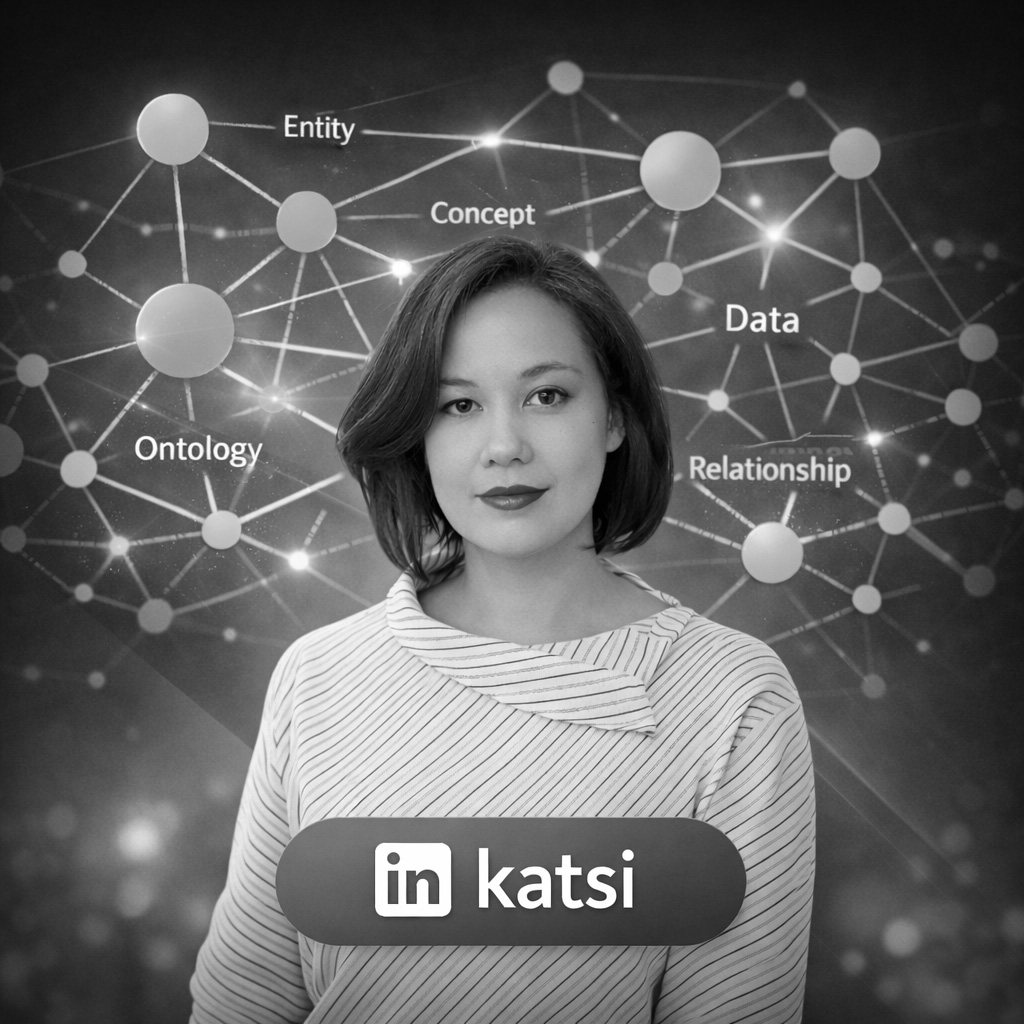
Katariina Kari (ExClaM! Digital Oy)
FounderFrom Silos to Shared Practice – Making Data Everyone’s Business
In many organisations, data is treated as a secondary by-product of applications rather than the foundation of the business itself. This application-centric mindset creates silos, duplications, and fragile data ecosystems that fail to serve long-term strategic needs.
In this talk, I will share how organisations can shift towards data-centricity, where data development is a shared practice spanning management, product, and engineering. I’ll show what it looks like when the conceptual model of the business is also machine-readable—and why this matters for aligning data engineering with the organisation’s core concepts.
Drawing on experiences from major retail brands, and, most recently, building a data-centric organisation at the Finnish strategy start-up In Parallel, I will demonstrate how making data models explicit and machine-readable transforms both daily operations and long-term value creation.
Participants will leave with a clear understanding of what data-centricity looks like in practice and concrete ideas for how to take ownership of the central concepts in their business, ensuring that data is managed not just as a technical asset, but as a shared organisational responsibility.
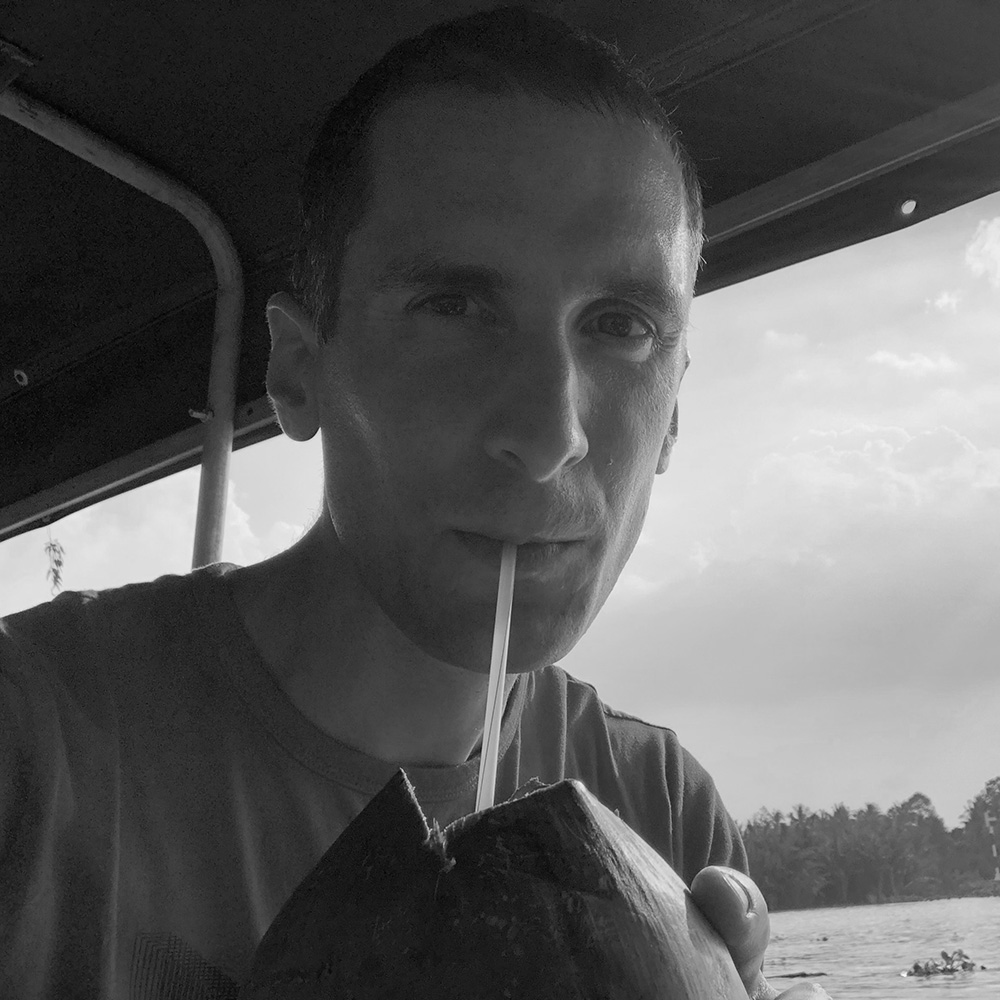
Alexandre Bertails (Netflix)
Software EngineerSemantic Interoperability at Scale with Conceptual RDF
At Netflix, dozens of data systems coexist: GraphQL APIs, Avro pipelines, Iceberg tables, Java services. Each defines its own schemas, its own understanding of what “Movie” or “Talent” means. When these definitions drift — and they always do — we pay for it in broken integrations and engineering hours spent asking: “Which system has the correct definition?”
Ontologies and knowledge graphs promise to solve data integration through semantic interoperability. Yet most enterprise initiatives don’t deliver — ours almost didn’t either. When we said “ontology,” engineers disengaged. When we introduced RDF, they assumed we wanted them to migrate data into a triple store. The tooling felt foreign, the vocabulary abstract. We had to ask ourselves: if this isn’t landing, what are we missing?
UDA (Unified Data Architecture) is what emerged. RDF powers the knowledge graph — domain models that formalize business concepts, data containers that capture both the physical systems and the schemas they expose, and mappings that connect the two — but the key insight is that RDF serves as a conceptual layer. Instance data stays where it is. Upper, our self-governing domain modeling framework, lets teams define concepts once and transpile them to GraphQL, Avro, Java, SQL — all consistent because they derive from the same formal conceptualization. This talk explores how Conceptual RDF can deliver semantic interoperability at scale without asking enterprises to rethink their entire data infrastructure.
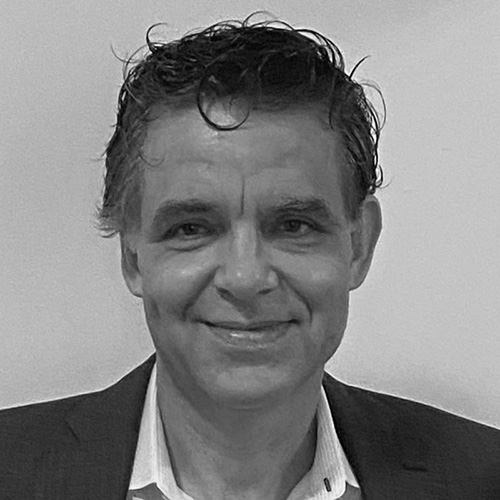
Mike Pool (Bloomberg)
Semantic Technology Product ManagerData Instance Registries and EKGs
In this presentation we will discuss data instance registries. What are they? What should be in them? What shouldn’t be in them? What role do they play in building a better Enterprise Knowledge Graph?

Andrei Seryi (PSI-CRO)
Director Knowledge Management, Process ImprovementUntangling Complexity: How Semantics Power the Future of Clinical Trials
I will convey the complexity of clinical trials at top level, the inefficiencies and pitfalls frequently arising from said complexity. Then discuss how semantic solutions have emerged as the top method at PSI to enable AI agents to simplify the complex, speed up and automate clinical research processes, while driving quality across the board.
For a specific use case, I plan to outline how SA-developed PSI enterprise ontology is used to digitize the protocol that serves as one of the main drivers for pretty much everything that is the clinical trial it is written for; and one of its uses in identifying medical institutions best suited for serving as sites in our client’s projects.

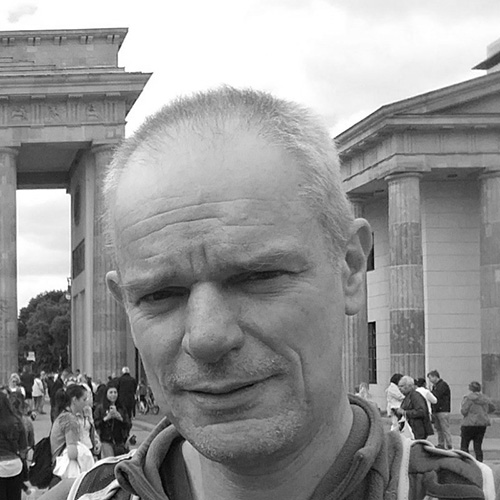
Ora Lassila (Amazon Neptune)
Principal Technologist
Nick Lynch (Curlew Research)
FounderSharing antiviral discovery data to accelerate therapeutic discovery in a resource-limited environment
Open science data sharing is essential for making the most of limited global investment in drug discovery for pandemic preparedness and endemic disease. Drug discovery is an incredibly expensive enterprise, where the total costs of failed discovery efforts are now so high that each approved drug costs over $2.5B in R&D investment. However, an enormous amount of valuable data, resources, reagents, and materials are generated in the course of a discovery program that can accelerate or jump-start other drug discovery efforts that take differentiated paths or aid biologists aiming to better understand viral biology to probe weaknesses. The limited global investment in drug discovery for pandemics, the enormous threat posed to humanity and lack of market incentive make it essential for these global resources to be used efficiently. By sharing drug discovery data openly, we can simultaneously coordinate global discovery efforts simply by making it possible for other efforts to known when we are working on similar targets and chemical series, help nucleate differentiated drug discovery efforts by enabling other teams to save huge amounts of time and money by starting from target-enabling packages, and aid researchers in better understanding viral biology by providing them with cheap chemical probes that will help dissect biochemical pathways.
The talk will cover:
Data sharing philosophy: Drug discovery efforts generate many useful outputs besides drugs. How this is being made available as data products and assets
Deposit data in FAIR repositories, provide useful high-level indexes: How ASAP is ensuring data and resources are ultimately deposited in appropriate disciplinary FAIR (Findable, Accessible, Interoperable, and Reusable) repositories and biological sample repositories.
Lessons learned and future plans for a broader therapeutics hub.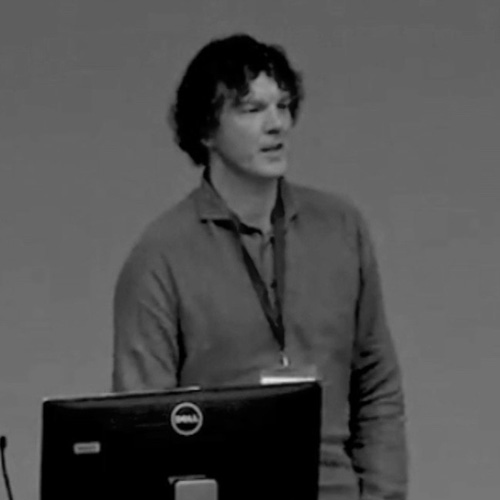
Dougal Watt (Graph Research Labs)
CEOThe Graph Middleware Layer: Bridging Ontologies and Enterprise Systems
Data-centric architecture promises a cleaner, more sustainable approach to enterprise data management. But even well-designed ontologies face a persistent challenge: how do you actually connect them to the systems, teams, and workflows that run the business?
This presentation introduces the concept of a graph middleware layer – a set of generated components that bridge the gap between semantic models and enterprise infrastructure. Using declarative ontology specifications, we will explore tools to produce REST APIs, React applications, and MCP servers that give engineering teams familiar development tools, languages and integration points without requiring graph expertise. The result is an ontology that models the business domain as well as actively participates in the enterprise technology stack.
We’ll explore how this middleware approach addresses common adoption barriers: developers get standard APIs they already know how to consume; operations teams deploy via Kubernetes and CI/CD pipelines; business users interact through generated applications rather than query languages. Meanwhile, ontologists retain full control of the semantic model, with all downstream artifacts staying aligned by design.
The session draws on ongoing work on a real implementation: a GIST-aligned FHIR R5 medications solution for the New Zealand health system. We’ll show how the middleware layer enabled rapid iteration, seamless legacy integration, and controlled LLM access via MCP – all generated from a single ontology source.
Data-centric thinking is key but the missing piece has been a practical path from ontology to operational systems. The graph middleware layer provides that path.

Bilal Ben Mahria (TeamEx)
AI & Ontology EngineerLarge Language Models as Generative Ontologists: Dilemmas and Pitfalls
The emergence of large language models (LLMs) as generative ontologists represents a paradigm shift in knowledge engineering, offering the unprecedented ability to rapidly produce structured knowledge frameworks from unstructured text at scale. This presentation critically examines the two-sided nature of this capability, exploring both the transformative potential and the profound challenges inherent in LLM-driven ontology generation. We navigate key dilemmas, such as the trade-offs between automation and accuracy, generalization and domain specificity, and open-world adaptability versus closed-world consistency, while exposing critical pitfalls including ontological hallucinations, amplified biases, logical inconsistencies, and evaluation ambiguities. By analyzing real-world cases and experimental outcomes, we found that LLMs serve best not as autonomous ontologists, but as powerful co-pilots in a hybrid human-AI workflow. The discussion concludes with a framework for responsible implementation, proposing validation strategies, governance models, and research directions to harness generative ontology engineering while mitigating its risks.

Ashleigh Faith (IsA DataThing YouTube Channel)
Founder and HostReducing Risk and Adding More Trustworthiness to AI through Knowledge Graphs (aka Context Graphs and Symbolic AI)
There is an assumption that knowledge graph data is accurate, but what many don’t realize is that the disagreements and conflicts within your own data, or the data that you have pulled in from other sources, can still cause hallucinations in your LLM RAG operations. Join me in this walk-through on how KG statements can be used for fact verification, data validation, and entity resolution to help your graph decrease LLM hallucinations.

Ben Gardner (AstraZeneca)
Senior DirectorEnabling new medicines via Scientific Intelligence a sematic knowledge graph that integrates multimodal clinical data
The pharmaceutical industry is at the forefront of developing precision medicines. Gone are the days when we broadly classified disease, now we have the understanding to characterise diseases to a fine grain. For example we once talked about cancer, then cancer of an organ, then cancer of a cell type and now we define cancers by specific mutational profiles. As our scientific understanding has grown we need to re-exam our previously collected clinical data to identify these subpopulations and create virtual cohorts of multi-modal (clinical observations, medical images, digital pathology, DNA sequencing, protein expression profiles, etc) from across multiple clinical trials that can be used to further understand a disease and enable the development of improved treatments for patients.
We have solved this challenge by delivering a semantic knowledge graph that integrates multiple data modalities from a range of diverse sources together. This information is then exposed via a user interface. Scientist are now able to perform tasks in minutes that previously took weeks or months of manual work.
This presentation will describe the challenges overcoming inconsistencies across data sources (>20 sources), dealing with massive data volumes (over 10 trillion triples), creating intuitive interfaces for a large complex graph and why we still need librarians.